There are those of you to whom this will mean something, and there are those of you to whom it won't.
Just click the link.
WHITE HORSES
Sigh....
Well folks. If you liked that, and you're sitting there all misty-eyed, then this is for you too. No visuals but listen to the music...
Tuesday, March 27, 2007


Monday, March 19, 2007
Playing YouTube clips
NOTE: To view the clips without annoying 'sticking', click on them to start the download, then hit the pause button at bottom left of the clip, and wait until the clip is fully loaded (ie. the red line has moved fully from left to right, below the video image). Then hit play, and it should run smoothly.
Monday, March 05, 2007
Now that's what I call music, Volume 1
Listen to Frank Zappa, The Prodigy, The Velvet Underground, Big Joe Turner, Quicksilver Messenger Service, Laurie Anderson and many more, in my virtual jukebox!
Below, you will find a selection of excellent music, hand-picked with loving care by me from YouTube. Pretty much the only thing they have in common is that I love them all.
I'll choose a selection every month from now on, so do come back and see what other gems I've unearthed in April.
In the meantime,if you hate Kraftwerk, or think Hank Williams is shit, don't despair. There is a massive variety of stuff here, and all of it is stuff you won't see or hear very often. If you don't like any of it, well, Volume 2 will be along in a month or so.
First up, one which usually divides people into love/hate camps. It's Canadian multimedia artist Laurie Anderson, with her surprise 1981 UK number 1, 'O Superman'.
Although the repeated "oh oh oh oh oh..." may get on your nerves initially, give it a chance; it becomes positively hypnotic after a minute or two. I've never researched what Laurie meant to say in this piece, but listening to the words leads me to believe that it's about the moment of detonation of the atomic bombs over Hiroshima and Nagasaki. The truncated "oh oh oh oh oh..." represents the reaction of the victims, perhaps the start of a word or sentence, or just an exclamation at the white light that ended the exclaimer's life, cut off and frozen in time forever by the annihilation of the bomb. The words speak of mundanities, messages left on answering machines, everyday lives brought to a sudden halt. The words "Here come the planes. Are they American planes?" are filled with menace once you place them in context. Chilling.
Sunday, March 04, 2007
Lunar eclipse
Last night (Saturday) was clear and beautiful. I wandered outside onto the decking in the back garden around 10.30pm to watch the silvery Moon slowly vanish into Earth's shadow, and take on a copper-red colour, as the Sun's light refracted through the Earth's dusty atmosphere. Fantastic.
Looking on the net for a nice pic, I found this superb composite series of images, taken by an unidentified photographer, which clearly and beautifully show the way the Moon's colour changed through the eclipse. Thanks, whoever you are....

Looking on the net for a nice pic, I found this superb composite series of images, taken by an unidentified photographer, which clearly and beautifully show the way the Moon's colour changed through the eclipse. Thanks, whoever you are....

The Epic
I went climbing on Friday. First time I've been on the rock for about a year! I did far more mountain biking and even walking last year than climbing, but this year I'm determined to do more climbing. After all, it's something I've been doing for 28 years and I don't want to become an ex-climber. I get far too much from it for that to happen.
I had a day off work, intending to use the good weather to trim back the big weeping willow in the garden. My mate John 'Simmo' Simpson rang, to arrange a mountain bike ride for Saturday, and on hearing I had the day off, suggested I come climbing with him and his mate Alex. Hmmm...climbing in the early spring sunshine, on God's own rock at Stanage, or climbing a tree to saw dead branches? Contest? I think not.
So a sunny but chilly afternoon saw the three of us stretching our collective rusty joints and muscles on the 'soaring crackline' of Robin Hood's Right-Hand Buttress Direct (HS4a), Inverted V (VS4b), Twin Chimneys Buttress (VS4c) and Heather Wall (VS4c).
Bloody hell it was good to be climbing again after such a long lay-off! I was a bit creaky and my confidence isn't all it should be, so VS is about as much as I felt up to, but I'm determined now to try and get on the crag more regularly. Maybe I'll finally get round to screwing my plastic holds to the outside of the house to finish my traversing wall, and maybe I'll even replace my 20 year old Scarpa Cragratz with some more modern footwear (probably just get 'em resoled again though).
Below: looking up the groove of Inverted V to the exposed finishing moves (Photo by James Parratt, from the UKClimbing.com photo database. Climber: James)

Below: Heather Wall (Photo by Lizard, from UKClimbing.com database. Climber: Amanda James)
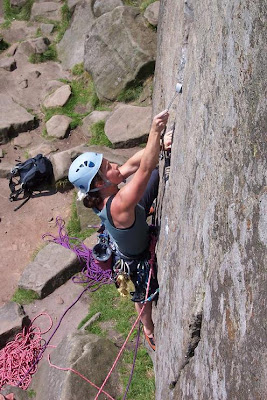
Incidentally, we went out on the mountain bikes yesterday, setting off from Castleton for a circuit more or less around Mam Tor, taking in much of Rushup Edge and the hairy descent down the Chapel Gate track. It was a great little circuit, even though I had a bit of a skidding nightmare on the technical descent to Greenlands from the Mam Nick bus stop. The mud was so sticky it just clogged my tyres up and I lost any grip. The slightest touch on the front brake or change of direction simply sent the bike sideways. How Simmo managed to stay on I don't know. It didn't help that my Time cleats are so worn that my left foot comes unclipped at every bump. Not good when you're flying down a rocky obstacle course at speed. Must replace them, although the shoes are falling apart as it is. Maybe time to look on ebay and see if I can find some cheap replacements.
Hmmm...I haven't got any recent pics of me climbing. The best I have are these:
Below: Me on Lancet Crack, VS5a, Brimham, in 2004 (Photo by Simon Jacques)...

Me on Great Western, Almscliff, in 2003...

I had a minor epic on Great Western, which puts me in mind of this poem which I wrote, about having an epic on a hard climb...
The epic
This is easy, even fun.
Climbing up past cracks,
their protection eschewed in misplaced confidence.
Moving smoothly, strongly upwards,
unknowingly striving towards a desert
of fear and unexpected exhaustion
(you'll know it when you get there)
Movement falters then stops
with a sudden stab of regret
at those ignored cracks.
Cast adrift in a sea of rising panic,
as veins bulge like wire,
and arms begin to sing their fading song.
The grey stone sighs and hums,
looking the other way,
offering nothing to help.
No relief, no purchase, another loser, NEXT!
Shaking and sweating,
panicked grimace versus cold face
staring impassively, eyeless,
at, through and beyond,
indifferent to the drama of the personal
and the frailty of the organic.
Death whispers in the distant ground,
the final spotter, reliable to the end,
transmitting a silent siren call
up the rope’s increasingly dead weight.
The imaginary creep of rubber on rock,
the start of sweat from face and finger,
breed sheer fear.
Legs burn and scream.
Arms fossilise, cement-like.
Looking up in desperation,
as hunter becomes hunted,
with all tables turned.
Now it’s fight or a free flight
to your final destination.
Here come your final moments,
seconds from the end of all things.
Fingers whiten in their grip on disappearing life,
as the other hand is whitened,
catching in the bag,
then reaching up.
Iron calves are bellowing
like old machines made to turn.
A hand of pink bananas, all thick skin and mush
finds sanctuary in the everted cathedral,
A salty echo of the sea
falls from a sniveling nose
through an eternity of empty air
to explode against another dimension.
Soon to be followed by a redder splash?
The white knuckles ride
on the Ultimate, Oblivion, Nemesis!
But sanctuary is squared!
Feet now skitter and scrape in a bad dance.
Engines misfire and cough,
sucking the dregs of fuel.
Death laughs now and opens his arms.
The rubber and rock find a new embrace.
Ridiculous banana finger parodies
make the cold face crack a thin smile.
The joke is shared!
Holding on, looking down,
fumbling for aeons with heavy jewellery.
Looking for the right bling to keep that grin.
Offering accepted, the dead weight of purple cord,
still touching death’s disappointed sulk down below,
adds years of life with just one automatic action.
One clip.
The Cumbrian Rope Trick.
One clip brings
life,
sun,
wind,
sound,
a universe
which seconds ago wasn’t there.
The beckoning ground is now above,
just out of sight,
almost within reach.
That was originally posted by me on the multi-faceted forum community at Fex Wezner's Art Forum. You can be sure to find a forum on there to suit you.
I had a day off work, intending to use the good weather to trim back the big weeping willow in the garden. My mate John 'Simmo' Simpson rang, to arrange a mountain bike ride for Saturday, and on hearing I had the day off, suggested I come climbing with him and his mate Alex. Hmmm...climbing in the early spring sunshine, on God's own rock at Stanage, or climbing a tree to saw dead branches? Contest? I think not.
So a sunny but chilly afternoon saw the three of us stretching our collective rusty joints and muscles on the 'soaring crackline' of Robin Hood's Right-Hand Buttress Direct (HS4a), Inverted V (VS4b), Twin Chimneys Buttress (VS4c) and Heather Wall (VS4c).
Bloody hell it was good to be climbing again after such a long lay-off! I was a bit creaky and my confidence isn't all it should be, so VS is about as much as I felt up to, but I'm determined now to try and get on the crag more regularly. Maybe I'll finally get round to screwing my plastic holds to the outside of the house to finish my traversing wall, and maybe I'll even replace my 20 year old Scarpa Cragratz with some more modern footwear (probably just get 'em resoled again though).
Below: looking up the groove of Inverted V to the exposed finishing moves (Photo by James Parratt, from the UKClimbing.com photo database. Climber: James)

Below: Heather Wall (Photo by Lizard, from UKClimbing.com database. Climber: Amanda James)

Incidentally, we went out on the mountain bikes yesterday, setting off from Castleton for a circuit more or less around Mam Tor, taking in much of Rushup Edge and the hairy descent down the Chapel Gate track. It was a great little circuit, even though I had a bit of a skidding nightmare on the technical descent to Greenlands from the Mam Nick bus stop. The mud was so sticky it just clogged my tyres up and I lost any grip. The slightest touch on the front brake or change of direction simply sent the bike sideways. How Simmo managed to stay on I don't know. It didn't help that my Time cleats are so worn that my left foot comes unclipped at every bump. Not good when you're flying down a rocky obstacle course at speed. Must replace them, although the shoes are falling apart as it is. Maybe time to look on ebay and see if I can find some cheap replacements.
Hmmm...I haven't got any recent pics of me climbing. The best I have are these:
Below: Me on Lancet Crack, VS5a, Brimham, in 2004 (Photo by Simon Jacques)...

Me on Great Western, Almscliff, in 2003...

I had a minor epic on Great Western, which puts me in mind of this poem which I wrote, about having an epic on a hard climb...
The epic
This is easy, even fun.
Climbing up past cracks,
their protection eschewed in misplaced confidence.
Moving smoothly, strongly upwards,
unknowingly striving towards a desert
of fear and unexpected exhaustion
(you'll know it when you get there)
Movement falters then stops
with a sudden stab of regret
at those ignored cracks.
Cast adrift in a sea of rising panic,
as veins bulge like wire,
and arms begin to sing their fading song.
The grey stone sighs and hums,
looking the other way,
offering nothing to help.
No relief, no purchase, another loser, NEXT!
Shaking and sweating,
panicked grimace versus cold face
staring impassively, eyeless,
at, through and beyond,
indifferent to the drama of the personal
and the frailty of the organic.
Death whispers in the distant ground,
the final spotter, reliable to the end,
transmitting a silent siren call
up the rope’s increasingly dead weight.
The imaginary creep of rubber on rock,
the start of sweat from face and finger,
breed sheer fear.
Legs burn and scream.
Arms fossilise, cement-like.
Looking up in desperation,
as hunter becomes hunted,
with all tables turned.
Now it’s fight or a free flight
to your final destination.
Here come your final moments,
seconds from the end of all things.
Fingers whiten in their grip on disappearing life,
as the other hand is whitened,
catching in the bag,
then reaching up.
Iron calves are bellowing
like old machines made to turn.
A hand of pink bananas, all thick skin and mush
finds sanctuary in the everted cathedral,
A salty echo of the sea
falls from a sniveling nose
through an eternity of empty air
to explode against another dimension.
Soon to be followed by a redder splash?
The white knuckles ride
on the Ultimate, Oblivion, Nemesis!
But sanctuary is squared!
Feet now skitter and scrape in a bad dance.
Engines misfire and cough,
sucking the dregs of fuel.
Death laughs now and opens his arms.
The rubber and rock find a new embrace.
Ridiculous banana finger parodies
make the cold face crack a thin smile.
The joke is shared!
Holding on, looking down,
fumbling for aeons with heavy jewellery.
Looking for the right bling to keep that grin.
Offering accepted, the dead weight of purple cord,
still touching death’s disappointed sulk down below,
adds years of life with just one automatic action.
One clip.
The Cumbrian Rope Trick.
One clip brings
life,
sun,
wind,
sound,
a universe
which seconds ago wasn’t there.
The beckoning ground is now above,
just out of sight,
almost within reach.
That was originally posted by me on the multi-faceted forum community at Fex Wezner's Art Forum. You can be sure to find a forum on there to suit you.
Monday, February 26, 2007
The cruelty of whaling in the 19th century

Above: a 19th century whaler
I spoke in my last article about the proud history of the old, hand-harpoon days of whaling, and even the romance which surrounds it, certainly when compared with the brutally efficient murder of the modern counterpart, which gives the whale virtually no chance of escape.
The 19th century whalers, in the heyday of the industry, hunted using hand-thrown harpoons and lances, and whales, even when harpooned, would often escape, or turn on their attackers, smashing men and boats to pieces.
I don't want to glorify the early whaling industry, as it was the start of the indiscriminate slaughter which decimated the populations of these wild creatures. Although I have some admiration for the men, who were undeniably brave, I still regard it as a brutal slaughter, though one which, back then, at least brought the man into intimate contact with his living quarry, and which furnished a product to industry for which there was no equal substitute at the time.
I can understand that there was a genuine demand for the products of whaling. It was an industry which serviced a real need, as opposed to today's artificially subsidised factory process. Once the harpoon-cannon was introduced however, the whales were doomed, and the rate of killing outstripped the need for the products.
Ultimately, artificial whale-oil substitutes became available, and there was no need for the slaughter to continue. But continue it did, in a way reminiscent of the unrestrained slaughter of the American Bison, stopping only when the dwindling whale stocks threatened the existence of the industry itself.
It was as if the existence of the industry was reason in itself to carry on whaling. Very much as the farming industry is supported now, despite massive over-production, when it should really be left to market forces, and its scale adjust accordingly, with some farms returning to scrub, marsh and woodland, and the workforce redeployed in other industries. I can't agree with keeping an industry on life support, especially one which is so barbaric and uncompassionate.
The old-time whalers were, i suspect, capable of far more feeling and compassion for the animals they hunted. That's not to say they had any sentimentality about it, but when you have to look someone in the eye and use a piece of cold steel to kill them, you are inevitably going to feel differently to a man behind a big cannon, tens of metres from his victim, physically, and a million miles spiritually and emotionally.
My heart aches when I think of the age of some of the huge animals which perished, stuck through with whaler's lances, choking on their own blood, vainly trying to draw breath with punctured lungs. The whales may at least have had a chance of getting away, but their death was as slow and painful as any since.
To get an idea of the mentality of the old whalers, and the means by which they hunted and killed the whales, I urge you to read this, from Herman Melville's magnificent 'Moby Dick'. A breathtaking piece of writing. Remember that Melville served on a whaler, and this is the reality of the kill, drawn from Melville's first hand experience. The description of this particular hunt is relentless, cruel, exciting, and ultimately, heartbreaking:
(note: I've edited the chapter slightly to remove elements not directly concerned with the pursuit and kill)
"There were eight whales, an average pod. Aware of their danger, they were going all abreast with great speed straight before the wind, rubbing their flanks as closely as so many spans of horses in harness. They left a great, wide wake, as though continually unrolling a great wide parchment upon the sea.
Full in this rapid wake, and many fathoms in the rear, swam a huge, humped old bull, which by his comparatively slow progress, as well as by the unusual yellowish incrustations overgrowing him, seemed afflicted with the jaundice, or some other infirmity. Whether this whale belonged to the pod in advance, seemed questionable; for it is not customary for such venerable leviathans to be at all social. Nevertheless, he stuck to their wake, though indeed their back water must have retarded him, because the white-bone or swell at his broad muzzle was a dashed one, like the swell formed when two hostile currents meet. His spout was short, slow, and laborious; coming forth with a choking sort of gush, and spending itself in torn shreds, followed by strange subterranean commotions in him, which seemed to have egress at his other buried extremity, causing the waters behind him to upbubble.
"Who's got some paregoric?" said Stubb, "he has the stomach-ache, I'm afraid. Lord, think of having half an acre of stomach-ache! Adverse winds are holding mad Christmas in him, boys. It's the first foul wind I ever knew to blow from astern; but look, did ever whale yaw so before? it must be, he's lost his tiller."
As an overladen Indiaman bearing down the Hindostan coast with a deck load of frightened horses, careens, buries, rolls, and wallows on her way; so did this old whale heave his aged bulk, and now and then partly turning over on his cumbrous rib-ends, expose the cause of his devious wake in the unnatural stump of his starboard fin. Whether he had lost that fin in battle, or had been born without it, it were hard to say.
"Only wait a bit, old chap, and I'll give ye a sling for that wounded arm," cried cruel Flask, pointing to the whale-line near him.
"Mind he don't sling thee with it," cried Starbuck. "Give way, or the German will have him."
With one intent all the combined rival boats were pointed for this one fish, because not only was he the largest, and therefore the most valuable whale, but he was nearest to them, and the other whales were going with such great velocity, moreover, as almost to defy pursuit for the time.
It was a terrific, most pitiable, and maddening sight. The whale was now going head out, and sending his spout before him in a continual tormented jet; while his one poor fin beat his side in an agony of fright. Now to this hand, now to that, he yawed in his faltering flight, and still at every billow that he broke, he spasmodically sank in the sea, or sideways rolled towards the sky his one beating fin. So have I seen a bird with clipped wing making affrighted broken circles in the air, vainly striving to escape the piratical hawks. But the bird has a voice, and with plaintive cries will make known her fear; but the fear of this vast dumb brute of the sea, was chained up and enchanted in him; he had no voice, save that choking respiration through his spiracle, and this made the sight of him unspeakably pitiable; while still, in his amazing bulk, portcullis jaw, and omnipotent tail, there was enough to appal the stoutest man who so pitied.
Seeing now that but a very few moments more would give the Pequod's boats the advantage, and rather than be thus foiled of his game, Derick chose to hazard what to him must have seemed a most unusually long dart, ere the last chance would for ever escape.
But no sooner did his harpooneer stand up for the stroke, than all three tigers--Queequeg, Tashtego, Daggoo--instinctively sprang to their feet, and standing in a diagonal row, simultaneously pointed their barbs; and darted over the head of the German harpooneer, their three Nantucket irons entered the whale. Blinding vapours of foam and white-fire! The three boats, in the first fury of the whale's headlong rush, bumped the German's aside with such force, that both Derick and his baffled harpooneer were spilled out, and sailed over by the three flying keels.
"Don't be afraid, my butter-boxes," cried Stubb, casting a passing glance upon them as he shot by; "ye'll be picked up presently--all right--I saw some sharks astern--St. Bernard's dogs, you know--relieve distressed travellers. Hurrah! this is the way to sail now. Every keel a sunbeam! Hurrah!--Here we go like three tin kettles at the tail of a mad cougar! This puts me in mind of fastening to an elephant in a tilbury on a plain--makes the wheel-spokes fly, boys, when you fasten to him that way; and there's danger of being pitched out too, when you strike a hill. Hurrah! this is the way a fellow feels when he's going to Davy Jones--all a rush down an endless inclined plane! Hurrah! this whale carries the everlasting mail!"
But the monster's run was a brief one. Giving a sudden gasp, he tumultuously sounded. With a grating rush, the three lines flew round the loggerheads with such a force as to gouge deep grooves in them; while so fearful were the harpooneers that this rapid sounding would soon exhaust the lines, that using all their dexterous might, they caught repeated smoking turns with the rope to hold on; till at last--owing to the perpendicular strain from the lead-lined chocks of the boats, whence the three ropes went straight down into the blue--the gunwales of the bows were almost even with the water, while the three sterns tilted high in the air. And the whale soon ceasing to sound, for some time they remained in that attitude, fearful of expending more line, though the position was a little ticklish. But though boats have been taken down and lost in this way, yet it is this "holding on," as it is called; this hooking up by the sharp barbs of his live flesh from the back; this it is that often torments the Leviathan into soon rising again to meet the sharp lance of his foes. Yet not to speak of the peril of the thing, it is to be doubted whether this course is always the best; for it is but reasonable to presume, that the longer the stricken whale stays under water, the more he is exhausted. Because, owing to the enormous surface of him--in a full grown sperm whale something less than 2000 square feet--the pressure of the water is immense. We all know what an astonishing atmospheric weight we ourselves stand up under; even here, above-ground, in the air; how vast, then, the burden of a whale, bearing on his back a column of two hundred fathoms of ocean! It must at least equal the weight of fifty atmospheres. One whaleman has estimated it at the weight of twenty line-of-battle ships, with all their guns, and stores, and men on board.
As the three boats lay there on that gently rolling sea, gazing down into its eternal blue noon; and as not a single groan or cry of any sort, nay, not so much as a ripple or a bubble came up from its depths; what landsman would have thought, that beneath all that silence and placidity, the utmost monster of the seas was writhing and wrenching in agony! Not eight inches of perpendicular rope were visible at the bows. Seems it credible that by three such thin threads the great Leviathan was suspended like the big weight to an eight day clock.
Suspended? and to what? To three bits of board. Is this the creature of whom it was once so triumphantly said--"Canst thou fill his skin with barbed irons? or his head with fish-spears? The sword of him that layeth at him cannot hold, the spear, the dart, nor the habergeon: he esteemeth iron as straw; the arrow cannot make him flee; darts are counted as stubble; he laugheth at the shaking of a spear!" This the creature? this he? Oh! that unfulfilments should follow the prophets. For with the strength of a thousand thighs in his tail, Leviathan had run his head under the mountains of the sea, to hide him from the Pequod's fish-spears!
In that sloping afternoon sunlight, the shadows that the three boats sent down beneath the surface, must have been long enough and broad enough to shade half Xerxes' army. Who can tell how appalling to the wounded whale must have been such huge phantoms flitting over his head!
"Stand by, men; he stirs," cried Starbuck, as the three lines suddenly vibrated in the water, distinctly conducting upwards to them, as by magnetic wires, the life and death throbs of the whale, so that every oarsman felt them in his seat. The next moment, relieved in great part from the downward strain at the bows, the boats gave a sudden bounce upwards, as a small icefield will, when a dense herd of white bears are scared from it into the sea.
"Haul in! Haul in!" cried Starbuck again; "he's rising."
The lines, of which, hardly an instant before, not one hand's breadth could have been gained, were now in long quick coils flung back all dripping into the boats, and soon the whale broke water within two ship's lengths of the hunters.
His motions plainly denoted his extreme exhaustion. In most land animals there are certain valves or flood-gates in many of their veins, whereby when wounded, the blood is in some degree at least instantly shut off in certain directions. Not so with the whale; one of whose peculiarities it is to have an entire non-valvular structure of the blood-vessels, so that when pierced even by so small a point as a harpoon, a deadly drain is at once begun upon his whole arterial system; and when this is heightened by the extraordinary pressure of water at a great distance below the surface, his life may be said to pour from him in incessant streams. Yet so vast is the quantity of blood in him, and so distant and numerous its interior fountains, that he will keep thus bleeding and bleeding for a considerable period; even as in a drought a river will flow, whose source is in the well-springs of far-off and undiscernible hills. Even now, when the boats pulled upon this whale, and perilously drew over his swaying flukes, and the lances were darted into him, they were followed by steady jets from the new made wound, which kept continually playing, while the natural spout-hole in his head was only at intervals, however rapid, sending its affrighted moisture into the air. From this last vent no blood yet came, because no vital part of him had thus far been struck. His life, as they significantly call it, was untouched.
As the boats now more closely surrounded him, the whole upper part of his form, with much of it that is ordinarily submerged, was plainly revealed. His eyes, or rather the places where his eyes had been, were beheld. As strange misgrown masses gather in the knot-holes of the noblest oaks when prostrate, so from the points which the whale's eyes had once occupied, now protruded blind bulbs, horribly pitiable to see. But pity there was none. For all his old age, and his one arm, and his blind eyes, he must die the death and be murdered, in order to light the gay bridals and other merry-makings of men, and also to illuminate the solemn churches that preach unconditional inoffensiveness by all to all. Still rolling in his blood, at last he partially disclosed a strangely discoloured bunch or protuberance, the size of a bushel, low down on the flank.
"A nice spot," cried Flask; "just let me prick him there once."
"Avast!" cried Starbuck, "there's no need of that!"
But humane Starbuck was too late. At the instant of the dart an ulcerous jet shot from this cruel wound, and goaded by it into more than sufferable anguish, the whale now spouting thick blood, with swift fury blindly darted at the craft, bespattering them and their glorying crews all over with showers of gore, capsizing Flask's boat and marring the bows. It was his death stroke. For, by this time, so spent was he by loss of blood, that he helplessly rolled away from the wreck he had made; lay panting on his side, impotently flapped with his stumped fin, then over and over slowly revolved like a waning world; turned up the white secrets of his belly; lay like a log, and died. It was most piteous, that last expiring spout. As when by unseen hands the water is gradually drawn off from some mighty fountain, and with half-stifled melancholy gurglings the spray-column lowers and lowers to the ground--so the last long dying spout of the whale.
Soon, while the crews were awaiting the arrival of the ship, the body showed symptoms of sinking with all its treasures unrifled. Immediately, by Starbuck's orders, lines were secured to it at different points, so that ere long every boat was a buoy; the sunken whale being suspended a few inches beneath them by the cords. By very heedful management, when the ship drew nigh, the whale was transferred to her side, and was strongly secured there by the stiffest fluke-chains, for it was plain that unless artificially upheld, the body would at once sink to the bottom.
It so chanced that almost upon first cutting into him with the spade, the entire length of a corroded harpoon was found imbedded in his flesh, on the lower part of the bunch before described. But as the stumps of harpoons are frequently found in the dead bodies of captured whales, with the flesh perfectly healed around them, and no prominence of any kind to denote their place; therefore, there must needs have been some other unknown reason in the present case fully to account for the ulceration alluded to. But still more curious was the fact of a lance-head of stone being found in him, not far from the buried iron, the flesh perfectly firm about it. Who had darted that stone lance? And when? It might have been darted by some Nor' West Indian long before America was discovered.
What other marvels might have been rummaged out of this monstrous cabinet there is no telling. But a sudden stop was put to further discoveries, by the ship's being unprecedentedly dragged over sideways to the sea, owing to the body's immensely increasing tendency to sink. However, Starbuck, who had the ordering of affairs, hung on to it to the last; hung on to it so resolutely, indeed, that when at length the ship would have been capsized, if still persisting in locking arms with the body; then, when the command was given to break clear from it, such was the immovable strain upon the timber-heads to which the fluke-chains and cables were fastened, that it was impossible to cast them off. Meantime everything in the Pequod was aslant. To cross to the other side of the deck was like walking up the steep gabled roof of a house. The ship groaned and gasped. Many of the ivory inlayings of her bulwarks and cabins were started from their places, by the unnatural dislocation. In vain handspikes and crows were brought to bear upon the immovable fluke-chains, to pry them adrift from the timberheads; and so low had the whale now settled that the submerged ends could not be at all approached, while every moment whole tons of ponderosity seemed added to the sinking bulk, and the ship seemed on the point of going over.
"Hold on, hold on, won't ye?" cried Stubb to the body, "don't be in such a devil of a hurry to sink! By thunder, men, we must do something or go for it. No use prying there; avast, I say with your handspikes, and run one of ye for a prayer book and a pen-knife, and cut the big chains."
"Knife? Aye, aye," cried Queequeg, and seizing the carpenter's heavy hatchet, he leaned out of a porthole, and steel to iron, began slashing at the largest fluke-chains. But a few strokes, full of sparks, were given, when the exceeding strain effected the rest. With a terrific snap, every fastening went adrift; the ship righted, the carcase sank."
That poor old bull, blind and unable to swim properly, run down and slaughtered, only to be released, to sink as so much shark-meat, to the bottom, a wasted death. Melville includes the description of the stone spear point dug from the whale, to illustrate its great age, and the tragedy of his death is deliberately evoked.
Melville felt for the whale, I'm sure. His compassion bleeds from that heartbreaking line:
"It was a terrific, most pitiable, and maddening sight. The whale was now going head out, and sending his spout before him in a continual tormented jet; while his one poor fin beat his side in an agony of fright."
That whole section makes for uncomfortable reading: it's like an old blind lame man being hunted down mercilessly, and slaughtered.
Of course, the whale, as a species, gets its own back, in the form of the almost supernatural Moby Dick, an old, white-humped bull who, despite his age, and the assorted ironmongery which is embedded in his ancient hide, is the polar antithesis of the weak, blind, wretched victim of the pursuit and murder described heretofore.

Though this is fiction, the same must have occurred many times, Wise old whales of a century's age or more, wise and with poor eyesight, like any elderly human, shepherded by their loving family, treated like so much meat. It's not just the age of the animal, or the fact that its wild, free life was ended, but the agonising slowness, the torture of that death.
The following links all lead to sites featuring whaling, largely taking an anti-whaling stance. Please visit them for a look at their argument. If you want the other side, the pro-whaling side, it's easy enough to find.
I make no pretence of balance. I'm resolutely anti-whaling and always have been.

Friday, February 23, 2007
Sympathy for the Sea Devil
SYMPATHY FOR THE SEA DEVIL
As a postscript to the last blog entry, I'd like to comment briefly on the 10m long Colossal Squid (Mesonychoteuthis hamiltoni) that was caught off Antarctica by a New Zealand trawler this week. Although the trawler was long-lining for Toothfish, and not out to catch the squid, i can't help feeling sad for the squid. Cephalopods, like whales, are intelligent creatures, relatively speaking, and a squid this size must have reached a ripe old age, so I feel total sympathy that it should suddenly find itself hooked and gaffed and dragged on board a fishing boat, although the scientific importance is significant.

Ah well, it's just the one. There was a Giant Squid (Architeuthis dux) that got hooked similarly last year by a Japanese boat, and was filmed thrashing frantically to escape. It only broke free by severing its own tentacle. There was also one, a female, which was hauled thrashing from the sea back in 2003. There's a low quality video clip of it here.
In many ways, these huge animals are like the whales; maginificent, rare, long-lived and slow-breeding. It's just as well they taste of ammonia, or I'm sure we'd be fishing for them too, and let's face it, other than people like me, who amongst the general public would sympathise with them?
No need for whaling

There has been a renewed interest in whaling recently, what with the recent IWC vote on lifting the ban on commercial whaling, and the ramming of a Japanese whaling ship, the Kaiko Maru, by a ship belonging to the marine conservation action group Sea Shepherd, making all the TV news programmes. Whether the ramming was deliberate, or not, is open to debate, as are the rights and wrongs of it. Everyone has their own views. Personally, anything which is done to necessitate a whaling vessel returning to port, as long as lives are not jeopardised, can only be a good thing. So if the ramming was deliberate, then I'd cautiously support it as direct action against what I view as a barbaric and unjustifiable industry.
Thing is, Sea Shepherd seem to be prepared to use some tactics which could cause serious harm to the people on the receiving end, such as hurling Butyric acid onto the decks of the whaling ships. I'm not sure if this is propaganda designed to discredit Sea Shepherd but, much as I decry whaling, particularly in its loathsome modern incarnation, I can not support chemical warfare against men who, whatever we may think of their industry, are, at the end of the day, just trying to earn money to support their families. Butyric acid is nasty stuff, and not merely "rancid butter" like SS claim on their website.
I won't digress here into the rights or wrongs of farming animals for meat. I'll state my opinions at the end of this blog.
So, what about whales? Why shouldn't we hunt them? Because they're intelligent? So are pigs, probably not far away on the scale from even the brighter whale species. So are octopus, but we'll happily stew them in wine. Fear and pain aren't functions of intelligence. Witness a mouse suffering death by a thousand bites at the hands of a cat. Not a particularly intelligent animal, but its pain and stress and suffering are manifest. Intelligence alone is not a sufficient criterion.
Beacuse they're so beautiful, huge, mysterious? Please. Looks are nothing. All life is pretty much equal in my eyes, but Giant Squid should count themselves lucky they're so terrifyingly hideous to most people's eyes (and taste like ammonia).
No, the reason whaling should be stopped is that, simply, there's no need.
Whales of all species were decimated by the introduction of intensive factory whaling fleets. Most large whale species are still, to this day, rare animals, compared with their numbers even a century ago. The claims that Minke and Fin whales are now at sustainable levels has yet to be verified, and their numbers are still way, way, below the populations of the 19th century.
But suppose the Japanese, and the Icelanders, and the Norweigians, and the suddenly numerous other nations clamouring for the whaling moratorium to be lifted, get their way. What then? Will these slow breeding giants be able to maintain their populations at present levels, with even modest hunting? I doubt it. And who's to say, when the whalers are out in the open ocean, that they might not 'mistakenly' harpoon a Humpback, or a Blue, or a Right? Once flensed, nobody would know. The log would say another Minke. Do they do DNA analysis on all catches? I don't know.
The fact is that, in general, we don't need to hunt and kill wild animals for our food. Particularly not rare, elusive animals such as these. OK, we hunt Red Deer in the UK. Yes, we do that. But we do it because we long ago killed off their natural predators, the wolves, so we have to, in effect, take the place of the wolf, or else the exploding deer populations will strip the highlands of their vegetation, forests will die back, the ecosystem which the deer form a part of, will slide off balance, or more so than it already is. We hunt rabbits, a species described as non-native, but which has been present in our country for centuries, so might as well be native. But they are not industries. They are haphazard, ad hoc, small scale hunts, and the prey are profligate, they are everywhere, to the point of being a nuisance. It's as much a cull as a hunt.
There are something like 16 billion humans on this planet. All these hairless apes simply can't live off other wild species, and we don't allow cannibalism, so what do we do? We farm. If we hunted for our meat, there'd be nothing left. In those areas of the Earth where 'bushmeat' is still a significant part of the local diet, such is the reduced nature of the habitat for the wild animals being hunted, and so efficient are the weapons and traps used by the hunters, that species are being decimated to the point of disappearance. It's not sustainable.
The oceans are no different to any other major habitat. If we start to hunt the larger (meatier), slower breeding animals which live there, we will, inevitably, drive them to the point of extinction. Look at the way stocks of common food fish have been expoited almost to the point of commercial non-viability. Cod, Herring, Haddock, Tuna. These are species which numbered in millions and which were, not so long since, viewed as pretty much inexhaustible. Yet we've managed to remove them in such numbers that they are, in some areas, almost absent. Do we want the same to happen to whales? It would happen a lot faster than with fish.
Perhaps the Japanese feel that the whales are there to be exploited, as are all other species, on land or in the sea. If they all get caught, to the point of extinction, that's unfortunate, but hey ho, a whale left swimming is a resource left unused. That's a cultural viewpoint which is rarely echoed by the Western mind, but in my opinion it's a lazy and arrogant way to think and it needs to change. Japan is advanced enough to ditch such barbarous arrogance, just as we've ditched bear-baiting, bull-baiting and hunting with hounds.
Let us also not forget that currently, most of the meat from the whales caught ends up in pet food. Some is sold for human consumption but public tastes have changed, even in Japan, and whale meat is no longer popular even there. It's a dead industry being kept alive as a matter of principle and a misguided sense of tradition. We whale because we can, not because we must or should.
The suddenly plentiful and eager African coastal nations who are demanding the right to take up whaling, no doubt see it as a way of making money, and many of them are poor places indeed. But suppose they wanted to kill their elephants, or their rhinos, gorillas or lions? Is the poverty of the nation a reason to look the other way and say "Oh, go on then..."

There is NO NEED for anyone to hunt these wild, rare animals for food. The whaling industry is about political and cultural posturing, not about feeding hungry mouths. Sorry Japan, if whaling is integral to your culture, then fuck your culture. You need to change.
Even if whales were as common as rabbits, I'd still be opposed to it, if only because of the brutal method of killing. When a harpoon explodes inside a whale, understandably often rendering it semi- or un- conscious, there is no easy way of determining whether it's actually dead or not, and, seemingly, it often isn't.
More to the point, if the kill is not clean, then there's no way to dispatch the mortally wounded animal, given both its size, and the fact that it is rolling about in often freezing cold, heaving seas. It is left to die slowly, over minutes or even as long as half an hour, or occasionally, it has been suggested, hauled onto the factory ship, stunned and weak but still living, to be cut up as it lies, immobile and mute, on the steel deck. The whaling boats are meant to re-harpoon the whale if the first one fails to kill it, or to use a high-velocity rifle to administer a coup de grace, but for reasons given, this is often messy and ineffective.

Whaling is an ancient industry, with proud traditions, fascinating history and even romance surrounding it. But the whaling of today bears little resemblance to that of the 19th century, when men were lowered into the sea in small boats to throw hand-harpoons at the surfacing whales. It was probably no less agonising for the whale - death by the sword as opposed to death by the bomb, but at least the whales had a chance. The whole thing is now so one-sided, the whale is doomed as soon as it's sighted.
The following links all lead to sites featuring whaling, largely taking an anti-whaling stance. Please visit them for a look at their argument. If you want the other side, the pro-whaling side, it's easy enough to find. I make no pretence of balance. I'm resolutely anti-whaling and always have been.

Below: a summary of my opinions on farming, killing and eating animals


We're so far removed from plants evolutionarily speaking, that we scarcely even consider them as living things, but as all organised multicellular organisms do, they struggle and fight for survival when threatened, and 'suffer' in their own way when killed, boiled or swallowed alive into the acids of our stomach. Bottom line: unless we can photosynthesise, or metabolise inorganic chemicals, we rely on the killing and eating of other living organisms to sustain our own lives. Every meal involves the sacrifice of a life.
Given the necessity to kill, I regard it as far preferable that animals are reared humanely, and killed in a strictly controlled manner, as quickly as possible, and that we do not plunder the limited populations of wild animals the planet harbours. You may disagree, I don't really care. I arrived at this position over many years, including 13 as a vegetarian.
Thing is, Sea Shepherd seem to be prepared to use some tactics which could cause serious harm to the people on the receiving end, such as hurling Butyric acid onto the decks of the whaling ships. I'm not sure if this is propaganda designed to discredit Sea Shepherd but, much as I decry whaling, particularly in its loathsome modern incarnation, I can not support chemical warfare against men who, whatever we may think of their industry, are, at the end of the day, just trying to earn money to support their families. Butyric acid is nasty stuff, and not merely "rancid butter" like SS claim on their website.
Assuming the acid-throwing assertion is true, Sea Shepherd may say that anyone prepared to fire an explosive harpoon into the body of a peaceful, fairly intelligent wild animal, to kill it brutally and painfully to provide meat for an almost non-existent market (let's not even discuss the risible "scientific research" pretence), deserves all they get. Well, that might be their viewpoint, but actions like throwing strong acids at people are, in my view, unjustified. Moreover, carrying out such actions risks losing a lot of the support they almost certainly have amongst the public of many nations. Killing or maiming people doesn't win supporters to your cause.
As to whaling, well it would be easy to call me a hypocrite, seeing as I support (by my eating habits) the rearing and systematic killing of animals for food. Is a whale different to a cow, or a pig, or a chicken? Well, the latter are all domesticated animals, bred down from wild ancestors, to serve as food animals. I sympathise with any animal which is killed to become food for another animal, but I see no difference between a stoat killing a rabbit, a lion an antelope, or a human a cow. Some animals have evolved to eat other animals. Humans, pigs, bears, rats, foxes and many other species are omnivores. We've evolved to be able to make use of pretty much anything edible, and as a result, other animal species are a naturally intrinsic component of our diet.
As to whaling, well it would be easy to call me a hypocrite, seeing as I support (by my eating habits) the rearing and systematic killing of animals for food. Is a whale different to a cow, or a pig, or a chicken? Well, the latter are all domesticated animals, bred down from wild ancestors, to serve as food animals. I sympathise with any animal which is killed to become food for another animal, but I see no difference between a stoat killing a rabbit, a lion an antelope, or a human a cow. Some animals have evolved to eat other animals. Humans, pigs, bears, rats, foxes and many other species are omnivores. We've evolved to be able to make use of pretty much anything edible, and as a result, other animal species are a naturally intrinsic component of our diet.
I won't digress here into the rights or wrongs of farming animals for meat. I'll state my opinions at the end of this blog.
So, what about whales? Why shouldn't we hunt them? Because they're intelligent? So are pigs, probably not far away on the scale from even the brighter whale species. So are octopus, but we'll happily stew them in wine. Fear and pain aren't functions of intelligence. Witness a mouse suffering death by a thousand bites at the hands of a cat. Not a particularly intelligent animal, but its pain and stress and suffering are manifest. Intelligence alone is not a sufficient criterion.
Beacuse they're so beautiful, huge, mysterious? Please. Looks are nothing. All life is pretty much equal in my eyes, but Giant Squid should count themselves lucky they're so terrifyingly hideous to most people's eyes (and taste like ammonia).
No, the reason whaling should be stopped is that, simply, there's no need.
Whales of all species were decimated by the introduction of intensive factory whaling fleets. Most large whale species are still, to this day, rare animals, compared with their numbers even a century ago. The claims that Minke and Fin whales are now at sustainable levels has yet to be verified, and their numbers are still way, way, below the populations of the 19th century.
But suppose the Japanese, and the Icelanders, and the Norweigians, and the suddenly numerous other nations clamouring for the whaling moratorium to be lifted, get their way. What then? Will these slow breeding giants be able to maintain their populations at present levels, with even modest hunting? I doubt it. And who's to say, when the whalers are out in the open ocean, that they might not 'mistakenly' harpoon a Humpback, or a Blue, or a Right? Once flensed, nobody would know. The log would say another Minke. Do they do DNA analysis on all catches? I don't know.
The fact is that, in general, we don't need to hunt and kill wild animals for our food. Particularly not rare, elusive animals such as these. OK, we hunt Red Deer in the UK. Yes, we do that. But we do it because we long ago killed off their natural predators, the wolves, so we have to, in effect, take the place of the wolf, or else the exploding deer populations will strip the highlands of their vegetation, forests will die back, the ecosystem which the deer form a part of, will slide off balance, or more so than it already is. We hunt rabbits, a species described as non-native, but which has been present in our country for centuries, so might as well be native. But they are not industries. They are haphazard, ad hoc, small scale hunts, and the prey are profligate, they are everywhere, to the point of being a nuisance. It's as much a cull as a hunt.
There are something like 16 billion humans on this planet. All these hairless apes simply can't live off other wild species, and we don't allow cannibalism, so what do we do? We farm. If we hunted for our meat, there'd be nothing left. In those areas of the Earth where 'bushmeat' is still a significant part of the local diet, such is the reduced nature of the habitat for the wild animals being hunted, and so efficient are the weapons and traps used by the hunters, that species are being decimated to the point of disappearance. It's not sustainable.
The oceans are no different to any other major habitat. If we start to hunt the larger (meatier), slower breeding animals which live there, we will, inevitably, drive them to the point of extinction. Look at the way stocks of common food fish have been expoited almost to the point of commercial non-viability. Cod, Herring, Haddock, Tuna. These are species which numbered in millions and which were, not so long since, viewed as pretty much inexhaustible. Yet we've managed to remove them in such numbers that they are, in some areas, almost absent. Do we want the same to happen to whales? It would happen a lot faster than with fish.
Perhaps the Japanese feel that the whales are there to be exploited, as are all other species, on land or in the sea. If they all get caught, to the point of extinction, that's unfortunate, but hey ho, a whale left swimming is a resource left unused. That's a cultural viewpoint which is rarely echoed by the Western mind, but in my opinion it's a lazy and arrogant way to think and it needs to change. Japan is advanced enough to ditch such barbarous arrogance, just as we've ditched bear-baiting, bull-baiting and hunting with hounds.
Let us also not forget that currently, most of the meat from the whales caught ends up in pet food. Some is sold for human consumption but public tastes have changed, even in Japan, and whale meat is no longer popular even there. It's a dead industry being kept alive as a matter of principle and a misguided sense of tradition. We whale because we can, not because we must or should.
The suddenly plentiful and eager African coastal nations who are demanding the right to take up whaling, no doubt see it as a way of making money, and many of them are poor places indeed. But suppose they wanted to kill their elephants, or their rhinos, gorillas or lions? Is the poverty of the nation a reason to look the other way and say "Oh, go on then..."
Below: a modern harpoon cannon, loaded with an explosive tipped harpoon, on South Georgia

There is NO NEED for anyone to hunt these wild, rare animals for food. The whaling industry is about political and cultural posturing, not about feeding hungry mouths. Sorry Japan, if whaling is integral to your culture, then fuck your culture. You need to change.
Even if whales were as common as rabbits, I'd still be opposed to it, if only because of the brutal method of killing. When a harpoon explodes inside a whale, understandably often rendering it semi- or un- conscious, there is no easy way of determining whether it's actually dead or not, and, seemingly, it often isn't.
More to the point, if the kill is not clean, then there's no way to dispatch the mortally wounded animal, given both its size, and the fact that it is rolling about in often freezing cold, heaving seas. It is left to die slowly, over minutes or even as long as half an hour, or occasionally, it has been suggested, hauled onto the factory ship, stunned and weak but still living, to be cut up as it lies, immobile and mute, on the steel deck. The whaling boats are meant to re-harpoon the whale if the first one fails to kill it, or to use a high-velocity rifle to administer a coup de grace, but for reasons given, this is often messy and ineffective.
Below: an explosive harpoon detonates inside the body of a Minke whale


Below: a mortally wounded Sperm whale spouts blood from its blowhole

Below: a dead(?) whale is hauled on board a whaling ship

Whaling is an ancient industry, with proud traditions, fascinating history and even romance surrounding it. But the whaling of today bears little resemblance to that of the 19th century, when men were lowered into the sea in small boats to throw hand-harpoons at the surfacing whales. It was probably no less agonising for the whale - death by the sword as opposed to death by the bomb, but at least the whales had a chance. The whole thing is now so one-sided, the whale is doomed as soon as it's sighted.
The following links all lead to sites featuring whaling, largely taking an anti-whaling stance. Please visit them for a look at their argument. If you want the other side, the pro-whaling side, it's easy enough to find. I make no pretence of balance. I'm resolutely anti-whaling and always have been.
Below: a summary of my opinions on farming, killing and eating animals

OK, we can choose not to eat meat, but it's natural that we do. So I'm not opposed to eating meat, and thereby, killing animals to provide that meat. What I do expect, and hope for, is that the animals I ultimately eat have a good quality of life, up to the point of slaughter, and that the slaughter is carried out as quickly and with as little suffering and pain as possible. Given that a pack of wolves will often tuck into a still struggling caribou, not bothering with the coup de grace before filling their bellies, the majority of the UKs food animals perhaps have a relatively easy death, if the correct slaughter procedures are adhered to. I do concur that, for the period immediately leading up to slaughter, and the seconds of the slaughter itself, however, the animal is both stressed and frightened. I know, I've seen it first hand in an abbatoir near Leeds.
Below: Chickens hung up to have their throats cut - probably the least humane non-religious slaughter method in the UK


Below: a frightened bullock restrained for stunning, prior to slaughter

Below: a stunned sheep has its throat cut in an abbatoir

We're so far removed from plants evolutionarily speaking, that we scarcely even consider them as living things, but as all organised multicellular organisms do, they struggle and fight for survival when threatened, and 'suffer' in their own way when killed, boiled or swallowed alive into the acids of our stomach. Bottom line: unless we can photosynthesise, or metabolise inorganic chemicals, we rely on the killing and eating of other living organisms to sustain our own lives. Every meal involves the sacrifice of a life.
Given the necessity to kill, I regard it as far preferable that animals are reared humanely, and killed in a strictly controlled manner, as quickly as possible, and that we do not plunder the limited populations of wild animals the planet harbours. You may disagree, I don't really care. I arrived at this position over many years, including 13 as a vegetarian.
Monday, February 19, 2007
List Of Contents

Congratulations Manchester United!
 Screen YOUR film at ShAFF 2009

CLIFFHANGER 2008

The Yawning Man

'Klunkerz'; a film about mountain bike history, and ShAFF opening night

Sheffield Adventure Film Festival 2008 - ShAFF

How I got into mountain biking
 Comet Holmes - Towser's comet

Just a cat: Farewell to Towser

VIRTUAL JUKEBOX FOR JULY, er....DECEMBER. DANCE!!(updated)
 Sheffield Documentary Film Festival 2007


Mountain bike crashes
 The return of Shirley Bassey

 Spooky Woods, Glentress. Mountain bike heaven!

 Blue tits and woodpeckers

 Germaine Greer - feminist crumpet

Now That's What I Call Music, Volume 2
 For whom The Bells, The Bells toll; a meeting with John Redhead

 White Horses

Now that's what I call music, Volume 1
Lunar eclipse
The Epic
 The cruelty of whaling in the 19th century
 Sympathy for the Sea Devil
 No need for whaling

Duckman, Rex the Runt and the sexual attractiveness of cartoon characters
 Justin Timberlake rules. Dylan sucks.

 The involuntary twitch

 Gorgon is a moron

 The M to P of Heavy Metal

 The Diver


Subscribe to:
Posts (Atom)